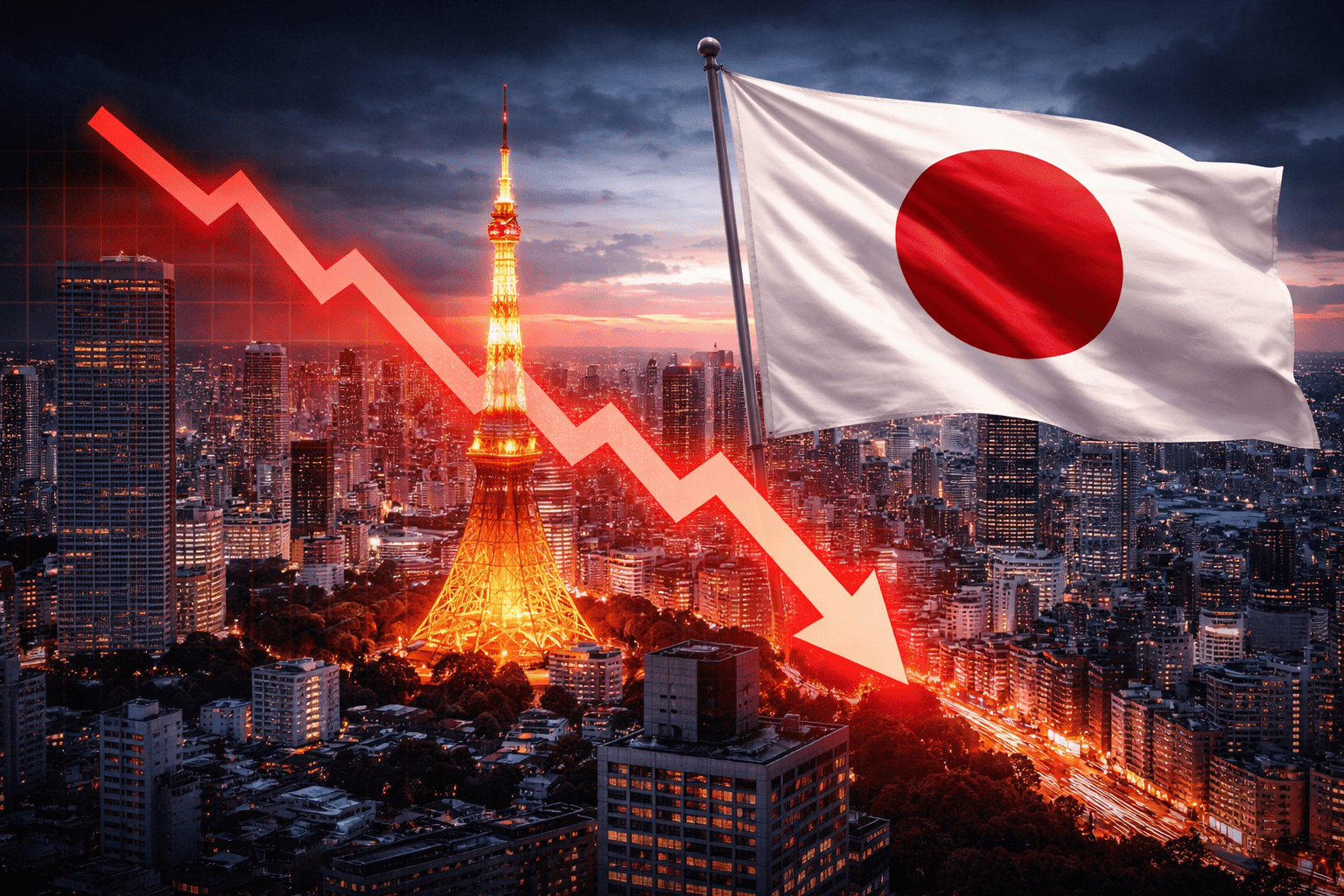
The Nikkei hit 59,332 on February 26 and was the best-performing index in 2026.
Two days later, the US and Israel attacked Iran.
And that timing explains almost everything about what has happened to Japanese markets since.
By March 30, the index had shed 13.1% for the month, the worst performance among all major global indices. The S&P 500 is down 7.2% over the same period, the DAX 7.5%, the CAC 6.1%.
Every market is hurting, but Japan is hurting the most. Nevertheless, some investors are finding reasons to remain bullish.
Why Japan got hit harder than anyone else
The short answer is geography and energy. Japan imports 87% of its total energy supply, the highest dependency in the G7.
Roughly 95% of its crude oil comes from the Middle East, and approximately 70% of that travels through the Strait of Hormuz.
For Germany, higher oil prices are a cost problem.
For the US, they are an inflation problem. For Japan, they are a supply problem. There is a meaningful difference between paying more for oil and potentially not getting it at all.
The government moved quickly. Japan has released 80 million barrels from its strategic reserves, the largest release in the country’s history, equivalent to 45 days of domestic demand.
Gasoline subsidies were reintroduced to cap pump prices at ¥170 per litre.
These are serious policy responses, and they bought time. Whether that time is enough depends entirely on how long the war lasts.
The yen is making everything worse
The dollar traded above ¥160 over the weekend of March 28.
That number is the threshold at which the Japanese government has historically intervened in currency markets.
Atsushi Mimura, the Vice Finance Minister for International Affairs, said on Monday that decisive measures may soon be necessary.
A weak yen was tolerable — and even useful for exporters — when oil was cheap.
At above $100 per barrel, a weak yen means Japan is paying significantly more in domestic currency for an import it cannot do without.
The oil shock and the currency weakness are compounding each other in a way that squeezes both corporate margins and household purchasing power simultaneously.
Real wages in Japan were still negative on a year-over-year basis in late 2025, despite the 2025 Shunto spring wage negotiations delivering 5.25%, the strongest wage growth in over three decades.
Oil above $100 and a yen at ¥160 per dollar threaten to undo much of that progress before consumers ever feel it.
The Bank of Japan is in an impossible position
At its March meeting, the Bank of Japan held rates at 0.75%, the highest level since 1995.
The vote was 8-1, with board member Hajime Takata dissenting in favour of an immediate hike to 1.0%.
The argument for hiking is taht inflation is running above 2%, oil is pushing it higher, and the yen needs support.
The argument against is equally straightforward: you do not tighten monetary policy when your economy is absorbing a major supply shock.
Raising rates into an oil crisis risks triggering the very recession it is meant to prevent.
Goldman Sachs had already cut its Japan GDP forecast to 0.8% for 2026 before the war began.
The OECD went further after it, lowering the eurozone to 0.8% and the UK to 0.7% as well.
The global slowdown from elevated oil prices is already being priced into growth forecasts across every major institution.
The structural story has not changed — it has just been buried
Before February 28, Japan was the best-performing major index in the world year-to-date, up over 12% as of early February.
The drivers were real. Corporate governance reform forcing companies to unwind cross-shareholdings and buy back stock at record rates, genuine wage growth for the first time in a generation, and an economy finally escaping deflation after thirty years.
TOPIX earnings per share growth is still forecast at 14% for fiscal year 2026.
None of that has changed. The war has placed a cyclical shock on top of a structural re-rating, and the two are being priced together as if they are the same thing.
The clearest evidence that sophisticated money is separating the two came on March 23, when Berkshire Hathaway announced a $1.8 billion investment in Tokio Marine, Japan’s largest insurer.
The deal was signed in the middle of the selloff, at a moment when most investors were selling.
Berkshire’s National Indemnity unit will join Tokio Marine’s reinsurance panel and collaborate on acquisitions, funded in part by the roughly $10 billion Tokio Marine is deploying from its own cross-shareholding unwind.
Ajit Jain, Berkshire’s insurance vice chairman, said:
We expect this strategic partnership to create compelling long-term opportunities for both organizations.
It was Berkshire’s sixth major Japan investment in seven years, adding to roughly $35 billion already held in Japanese trading companies.
The war ends at some point.
The cross-shareholding unwind, the wage cycle, and the corporate governance reforms do not go into reverse when it does. Berkshire understood that on March 23. The market will catch up eventually.
The post From best to worst: how Nikkei’s 2026 rally collapsed with Iran war appeared first on Invezz